UPDATE: The results of HighJam #1 are online. Berzerkatron got Second Place in Theme and Third Place in Graphics! Thank you to all those who have provided feedback. I have since updated a post-jam version of the game and to celebrate the results a new update has been uploaded. You can find out more on Itch.io.
As part of my effort to participate in one game jam a month, the month of February is HighJam. This is the first game jam is organised by HighSight Gaming, a Twitch Streamer who specialised in Indie Games with Indie Insights for a while (a show which Gemstone Keeper appeared twice on), although now it’s been replaced with a new show analysing classic games, In Hindsight.
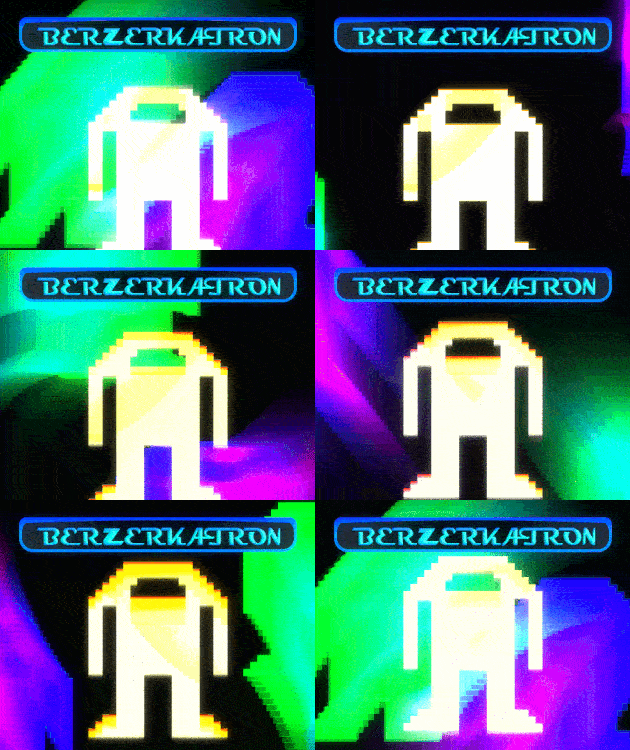
The theme of this jam was Atari Remakes, specifically to quote the description: “you must reimagine any Atari 2600 game of your choice”. One of my favourite 2600 games made by Atari was Berzerk, originally released at arcades in 1980 and was ported to 2600 in 1982. While the rules stated that I was not limited to the graphics, sounds and mechanics of the original, I felt like doing a “modernized” look wouldn’t do so well. The concept in my mind was to do a reimagining that would be in the style of Jeff Minter. It’s most likely due to the man’s past work, I had an image in my head of a “Berzerk 2000” of sorts, with a psychedelic feel, visually creative backgrounds and random sound samples.
Click here to go straight to the game!
Here is how I developed two of the most interesting concepts of this game:
The Level Rotating Transitions
This was a feature I was really keen to make, and once I found it was possible and implement, I wanted to keep silent about it so people can witness it while playing and see what their first reaction to it was, and when watching HighSight’s Playthrough (Skip to 01:54:30) I think it’s safe to say it worked. The initial version of the cube shader was by gre on gl-transitions.com, a website I’ve used recently for Gemstone Keeper.
The shader itself fakes perspective by skewing both textures so it appears thinner when further away, and moves both so it appears like a cube.
I modified the texture to remove the reflection at the bottom as it seemed unecessary and added a variable and functions so it could not only rotate it clockwise in the Y-Axis for horizontal transitions, but rotate it in the X-Axis for vertical transitions, it was then a case of using a uniform variable for me to define which direction I want the shader to rotate towards. You can check out the modified shader in the Assets folder of the game.
Randomized Levels
Funnily enough, having the levels be randomized wasn’t out to be creative but because I couldn’t think of a quick method of creating a huge array of level designs (the original Berzerk had somewhere in the range of 1024 different level variations!).
When looking through the original Atari version, I figured the levels were all configured into a 3×3 grid (I realised I was incorrect afterwards, as the Atari 2600 had 4×3 grid levels and the Arcade version had 5×3 levels), and then by defining each segment to a binary number I could determine which segment should have walls in either or all four directions.
I’d then construct a path between the player’s starting segment and the segments of each available exit, for the the remaining segments that have no value set, I’d use a random value. This last step had to be constrained as to have as few empty rooms as possible. However, as the above gif shows, not all levels are fully explorable. I also use the grid to determine which areas enemies and civilians should appear in.
Backgrounds
Unfortunately, I didn’t have the time to plan out or work on the brilliant background effects Jeff Minter develops, but GLSL-Sandbox is an excellent gallery of GLSL shaders that render brilliant visuals without any additional assets. I decided to pick ones that were monochromatic and were visually interesting without pointing too much attention from the game itself. I also used my multipass shader system to apply a shader that added a diamond gradient and another that made it possible to crossfade between different backgrounds.
Civilians
Interestingly, the idea of civilians to rescue (idea taken from Robotron and Llamatron) was kind of a last minute idea. I added this part of the game to encourage players to explore the level and add pressure to spend more time in the level while involving Evil Otto.
I did run out of time to implement some things I wanted like particle effects, but I’m happy I managed to get a playable version done. I did take one or two days off to have some leisure (and charity work) but I feel this is worthwhile. Hopefully enough people will vote and leave a good rating on this game.

 GAMEPOPPER